If you’ve only ever played cribbage with six cards dealt to each player, you’ve been playing what’s actually the newer version of the game. The original form of cribbage — still played today, mostly in parts of Britain — deals just five cards. It’s usually called five-card cribbage, and it plays noticeably differently from the version most American players learn.
Everything covered on this site so far — dealing, pegging, scoring — describes six-card cribbage, the standard game in the US and the most common two-player format worldwide today. This page covers how the five-card version differs, so you’ll recognize it if you come across it.
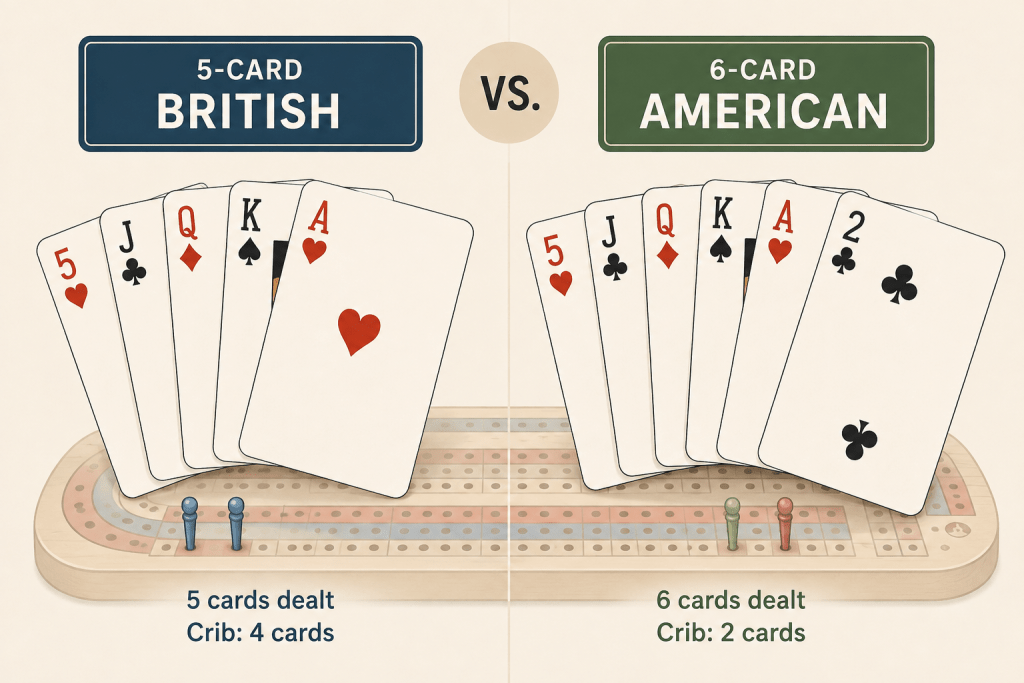
The Core Differences at a Glance
| Six-Card Cribbage (Standard) | Five-Card Cribbage (Original/British) | |
|---|---|---|
| Cards dealt per player | 6 | 5 |
| Cards discarded to the crib | 2 | 2 |
| Cards kept for play/show | 4 | 3 |
| Winning score | 121 points (twice around the board) | 61 points (once around the board) |
| Pone’s head start | None | 3 points (“three for last”), awarded once at the start of the game |
| End of the play (pegging) | New count restarts at 0 after 31 or a Go, play continues | Play ends immediately once 31 or a Go is reached |
| Flush in the hand | 4 points (5 if starter matches suit) | 3 points (4 if starter matches suit) |
| Where it’s played today | Standard in the US and most of the world | Survives mainly in parts of Great Britain, including club and pub play |
♠ Keep the Six-Card Rules Handy Too
Since most games you’ll run into use six-card rules, grab the free cheat sheet to keep scoring and pegging straight at the table.
Download the Free Cheat SheetHow Five-Card Cribbage Is Dealt
The deal itself is close to what you already know from Cribbage Dealing Rules, with a few key changes:
- Each player is dealt 5 cards instead of 6.
- Each player discards 2 cards to the crib — the same as six-card cribbage — but that leaves only 3 cards per player for the play and the show, instead of 4.
- Because the crib effectively holds more relative value in a shorter game, the non-dealer (pone) is given a 3-point head start, scored once at the very beginning of the game. This is traditionally called “three for last,” since it roughly offsets the dealer’s advantage of an extra crib later.
Scoring Differences
Most scoring works exactly the same as six-card cribbage — fifteens, pairs, runs, and his nobs are all counted the same way. The one real difference is the flush:
- In six-card cribbage, a flush in the hand scores 4 points (5 if the starter card matches suit too).
- In five-card cribbage, since players only hold 3 cards after discarding, a flush scores 3 points (4 if the starter matches).
There is no flush scoring during the play in either version — flushes only count during the show, same as always.
How the Play (Pegging) Differs
This is the biggest gameplay difference. In six-card cribbage, once a player reaches 31 (or both players say “Go”), the count simply resets to zero and play continues with whatever cards remain — see Cribbage Pegging Rules for the full breakdown.
In five-card cribbage, the play ends the moment someone hits 31 or a Go occurs. There’s no resetting and continuing — whatever cards are left in hand simply go straight to the show. Because each player only has 3 cards to begin with, this happens quickly, which is part of why five-card games move faster overall.
Winning the Game
Five-card cribbage is played to 61 points — once around a standard cribbage board — rather than the 121 points (twice around) used in six-card cribbage. Combined with smaller hands and fewer cards in play, five-card games tend to be shorter and involve smaller point swings per hand.
Skunk rules are less commonly applied to five-card cribbage, though some house rules and clubs do adapt a version of them — check local or club rules before assuming.
Which Version Should You Play?
- New to cribbage, or teaching someone? Start with six-card cribbage — it’s the version almost every app, board game night, and how-to guide (including this one) assumes by default.
- Want a faster game, or playing with only 3 cards worth of hand-reading? Five-card cribbage is quicker per hand and rewards different discard decisions, since you’re keeping far less of your dealt hand.
- Traveling to or playing with someone from the UK? Don’t assume six-card rules — ask which version they’re playing, since five-card cribbage is still common in British pub and club settings.
Frequently Asked Questions
Is five-card cribbage the “real” or “official” version?
Historically, yes — five-card cribbage came first. Six-card cribbage became dominant later and is now considered standard almost everywhere, including in official American Cribbage Congress tournament play.
Can I use the same cribbage board for both versions?
Yes. A standard board tracks up to 121 points either way — for five-card cribbage, players just stop at 61 (once around) instead of continuing to 121.
Does the crib work differently in five-card cribbage?
No — the crib is still formed from 2 discarded cards per player and still belongs to the dealer. See What Is the Crib in Cribbage? for a full explanation of how the crib works.
Are there five-card versions with 3 or 4 players?
Five-card cribbage is traditionally a 2-player game. For group formats, see our guides to Three-Player Cribbage and Four-Player Cribbage, which are based on the standard six-card game.