Dealing is the first step of every cribbage hand. While the process is simple, beginners often get confused about how many cards are dealt, when players discard, and how the crib is formed.
This page explains the official cribbage dealing rules, including how the dealer is chosen, how many cards are dealt, and common dealing mistakes to avoid.
If you want the full game flow, start here:
♠ Play Online — Free
Ready to see the full game in action?
Now that you know how the deal works, the best next step is to play a full hand and see the dealing, discarding, and starter card all happen together. I play on Tableza for free, against an AI, a friend, or real opponents online. No download needed.
Free to play · No download · Plays in your browser
Who Deals in Cribbage?
The first dealer is chosen by cutting the deck.
- Each player cuts the deck
- The player who cuts the lowest card becomes the dealer
- Aces are low
- Ties are re-cut
👉 Full explanation: Cutting for Deal in Cribbage
After the first hand, the deal alternates each round.
Why does the deal alternate?
The dealer has a built-in advantage — they score the crib on top of their hand every round. Alternating the deal ensures both players benefit equally from the crib over the course of the game. In a close match, who holds the deal at the right moment can be decisive.
How Many Cards Are Dealt?
In standard two-player cribbage:
- Each player is dealt 6 cards
- Cards are dealt one at a time, alternating between players
- All cards are dealt face down
After the deal, each player keeps their cards hidden from their opponent.
Discarding to the Crib
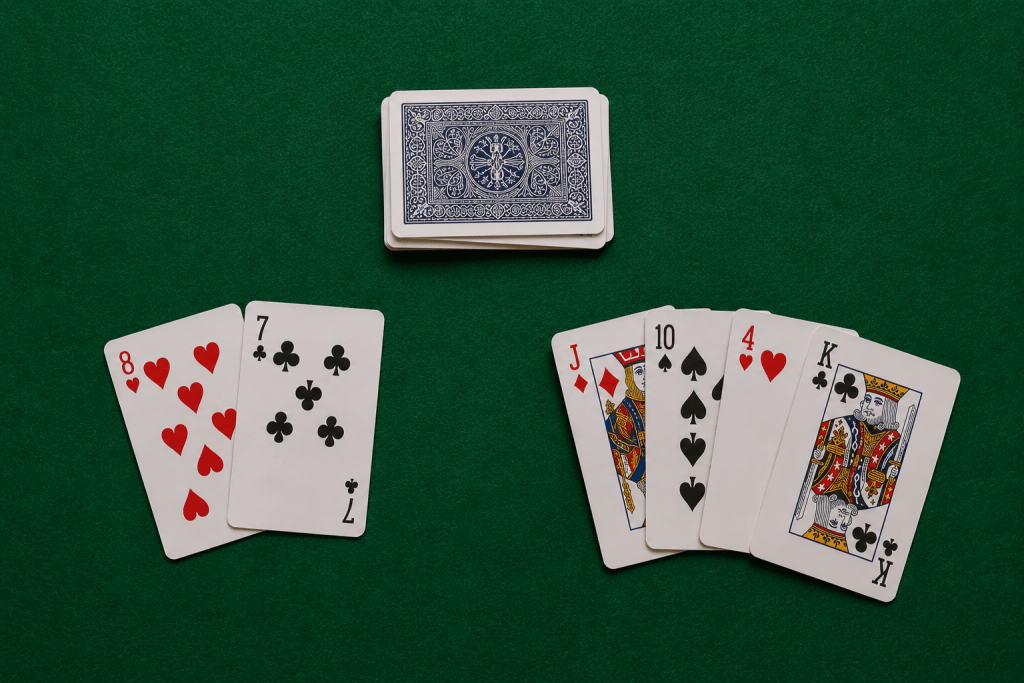
Once cards are dealt:
- Each player chooses 2 cards to discard
- These 4 cards form the crib
- The crib belongs to the dealer
After discarding, each player has 4 cards in hand.
👉 Learn what the crib is: What Is the Crib in Cribbage?
🃏 Free Printable
Free Cribbage Cheat Sheet (Printable)
New to cribbage? Download this free printable and keep it beside you while you play — covers scoring combinations, pegging examples, round order, and common beginner mistakes.
Instant PDF • Printable • Beginner friendly
Cutting the Starter Card
After discards are made:
- The non-dealer cuts the remaining deck
- The top card is revealed as the starter card
Special Rule: His Heels
- If the starter card is a Jack, the dealer immediately scores 2 points
👉 Learn how scoring works: Cribbage Scoring Explained
What Happens After the Deal?
Once the starter card is revealed:
- Pegging begins
- Players score points during play
- Hands and the crib are counted
👉 Pegging rules: Cribbage Pegging Rules
Dealing in Three- and Four-Player Cribbage
Dealing rules change depending on how many players are at the table. Here’s how each format compares:
| Rule | Two-Player | Three-Player | Four-Player |
|---|---|---|---|
| Cards dealt per player | 6 | 5 | 5 |
| Cards discarded per player | 2 | 1 | 1 |
| Extra card to crib | No | Yes (dealer adds 1) | No |
| Total cards in crib | 4 | 4 | 4 |
| Crib owner | Dealer | Dealer | Dealer’s team |
| Deal rotation | Alternates between 2 | Rotates clockwise | Rotates clockwise |
Why does the dealer add a card in three-player? With three players each discarding only one card, the crib would only have 3 cards — one short. The dealer adds a card from their hand after discarding to ensure the crib always has 4 cards, just like in every other format.
👉 Full three-player rules: Three-Player Cribbage
👉 Full four-player rules: Four-Player Cribbage
Common Cribbage Dealing Mistakes
Dealing the wrong number of cards — In two-player cribbage each player gets 6, not 5. In three- and four-player each player gets 5. Mixing these up is the most common dealing error.
Forgetting the dealer adds a card in three-player — With only one discard per player, the crib would be short without the dealer’s extra card. Easy to forget in the first few rounds of a three-player game.
Letting the non-dealer score the crib — The crib always belongs to the dealer, regardless of who built it. Non-dealers never score it.
Forgetting the His Heels bonus — If the starter card is a Jack, the dealer scores 2 points immediately. It’s easy to miss this in the flow of the game, especially for beginners.
Re-cutting for deal every hand — The cut only happens once at the very start of the game. After that, the deal simply alternates — no re-cutting needed.
Examining the crib before scoring — The crib must stay face down until it is time to score it after pegging and hand counting.
👉 Avoid these errors: Common Cribbage Mistakes
Quick Dealing Rules Summary
- Cards dealt: 6 per player
- Cards discarded: 2 per player
- Crib owner: Dealer only
- Starter Jack: Dealer scores 2 points
- Deal alternates after each hand
👉 One-page reference: Cribbage Cheat Sheet
Frequently Asked Questions
Do you deal 6 cards every time?
Yes, in standard two-player cribbage. In three- and four-player games, each player receives 5 cards instead.
Who cuts the starter card?
The non-dealer always cuts the deck after discards are made.
Does the dealer deal first every game?
No. The deal alternates after each hand. The player who did not deal last round becomes the dealer for the next.
What happens if you deal the wrong number of cards?
If the mistake is caught before anyone looks at their hand, redeal. If it’s caught after, the standard rule in casual play is to redeal regardless. In competitive play, specific misdeal rules may apply — check your tournament ruleset.
Can the dealer look at the crib before pegging starts?
No. The crib is set aside face down and cannot be examined by anyone until it is scored after pegging and hand counting.
Does the non-dealer always go first during pegging?
Yes. The non-dealer always leads the first card during pegging, every round.
Why does the lowest card win the cut for deal?
It’s simply the established convention in cribbage. Aces are low, and ties are broken by re-cutting. Some casual groups play highest card deals — agree before you start.
👉 More answers: Cribbage FAQ