The crib is one of the most important — and most misunderstood — parts of cribbage. Every hand includes a crib, and how it’s used can strongly influence the outcome of the game.
This guide explains what the crib is in cribbage, how it works, how it’s scored, and why discard decisions matter so much.
If you’re new to the game, start with the basics first:
What Is the Crib?
The crib is a separate hand made up of cards discarded by the players at the start of each round.
- Each player discards two cards into the crib
- The crib always belongs to the dealer
- The dealer scores the crib at the end of the round
The crib is counted after both players score their hands.
♠ Play Online — Free
See the pegboard in action — without needing a physical board
Tableza has an animated pegboard that moves in real time as you score — the easiest way to see how leapfrogging actually works in a live game. You can practice against an AI, a friend, or real opponents online. No download needed.
Free to play · No download
How the Crib Is Formed
In standard two-player cribbage:
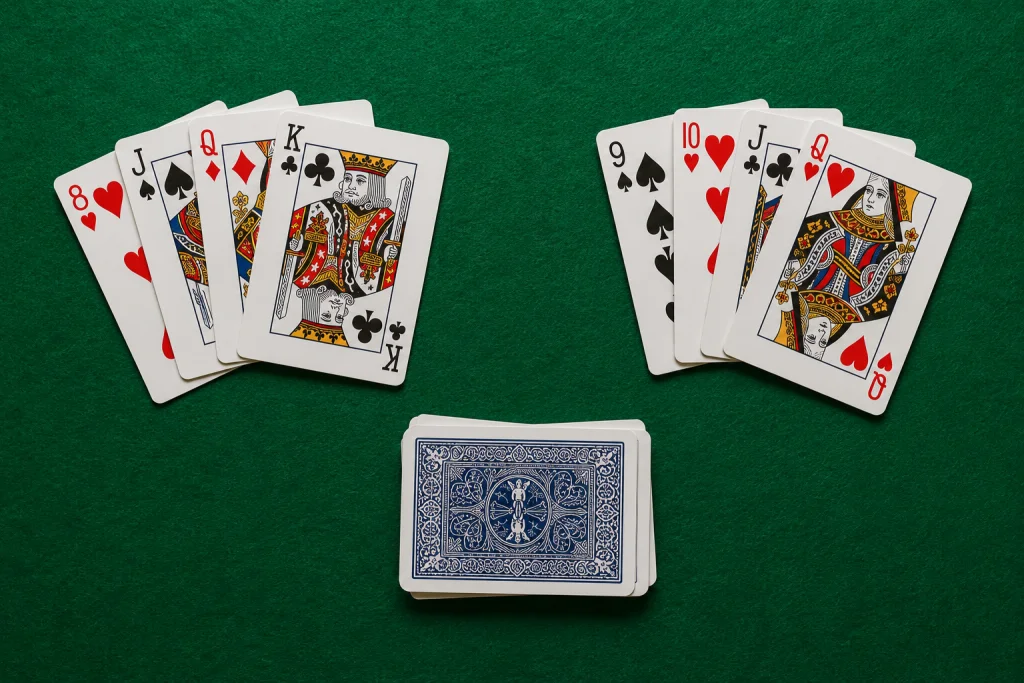
- Each player is dealt 6 cards
- Each player discards 2 cards into the crib
- The remaining 4 cards form each player’s hand
👉 Dealing explained: Cribbage Dealing Rules
Who Scores the Crib?
Only the dealer scores the crib.
This is a key rule and affects strategy:
- If you are the dealer, the crib helps you
- If you are not the dealer, the crib helps your opponent
Because of this, discard strategy changes every hand.
🃏 Free Printable
Free Cribbage Cheat Sheet (Printable)
New to cribbage? Download this free printable and keep it beside you while you play — covers scoring combinations, pegging examples, round order, and common beginner mistakes.
Instant PDF • Printable • Beginner friendly
How the Crib Is Scored
The crib is scored using almost the same rules as a regular hand.
It is scored for:
- Fifteens
- Pairs and multiples
- Runs
- Nobs
👉 Full scoring rules: Cribbage Scoring Explained
Crib Scoring Example
Crib cards: 5♣, 5♦, 9♠, J♥
Starter card: 6♦
| Category | Combination | Points |
|---|---|---|
| Fifteens | 5♣ + 9♠ + J♥ = … | — |
| Fifteens | 5♣ + 9♠ = 14… | — |
| Fifteens | 5♣ + J♥ = 15 | 2 |
| Fifteens | 5♦ + J♥ = 15 | 2 |
| Fifteens | 5♣ + 9♠ + … | — |
| Fifteens | 9♠ + 6♦ = 15 | 2 |
| Pairs | 5♣ + 5♦ | 2 |
| Runs | 5–6 (only 2 cards) | 0 |
| Flush | 4 cards same suit? No | 0 |
| Nobs | J♥ — does it match starter suit ♦? No | 0 |
| Total | 8 points |
Key things this example shows:
- The starter card (6♦) is always included when scoring the crib
- A pair of 5s scores 2 points even in the crib
- Each fifteen is counted separately — 5♣+J♥ and 5♦+J♥ are two different fifteens
- No flush scores because the 4 crib cards are not all the same suit — and the starter is a different suit too
Important Crib Flush Rule (Very Common Mistake)
Flush rules are stricter in the crib than in a regular hand.
| Situation | Regular Hand | Crib |
|---|---|---|
| 4 cards same suit (no starter) | ✅ 4 points | ❌ 0 points |
| 4 cards same suit + starter same suit | ✅ 5 points | ✅ 5 points |
| 5 cards all same suit | ✅ 5 points | ✅ 5 points |
In plain English:
- In your hand, 4 cards of the same suit scores 4 points even if the starter is a different suit
- In the crib, all 5 cards must match — 4 cards alone scores nothing
Example: Crib cards: 3♥, 7♥, 9♥, J♥ — all hearts. Starter card: K♠ — a spade.
- Regular hand: 4 points for the flush
- Crib: 0 points — the starter doesn’t match, so no flush scores
This trips up even experienced players. Always check the starter suit before claiming a crib flush.
👉 Avoid errors: Common Cribbage Mistakes
Why the Crib Is Strategically Important
The crib can:
- Add significant points for the dealer
- Swing close games
- Punish careless discards
Even a few extra crib points per game can change long-term results.
Discarding to Your Own Crib (Dealer Strategy)
When you are the dealer:
- You can discard more aggressively
- Feeding the crib is often beneficial
Strong cards for your own crib include:
- 5s
- Pairs
- Connected cards (like 6–7 or 9–10)
- Cards that total 15
👉 Full guide: Cribbage Discard Strategy
Discarding to Your Opponent’s Crib (Non-Dealer Strategy)
When you are not the dealer:
- Your goal is to limit crib value
- Defensive discards matter more than hand potential
Try to avoid discarding:
- 5s
- Pairs
- Connected cards
- Cards that easily form fifteens
Even “weak” cards can become dangerous in the crib.
The Crib and Pegging
Discard choices also affect pegging.
Poor discards can leave you with:
- Too many high cards
- Forced leads with 5s
- Weak pegging control
👉 Pegging basics: Cribbage Pegging Rules
Crib vs Hand Value
A common beginner mistake is focusing only on hand strength.
In reality:
- Dealer = hand + crib
- Non-dealer = hand – crib risk
Balancing these factors is a core cribbage skill.
👉 Beginner overview: Cribbage Strategy for Beginners
Example: Dealer vs Non-Dealer Discards
Your hand: 5♠, 6♦, 7♣, 9♥, K♠, Q♦
You have a solid run of three (5–6–7) plus two high cards and a 9. The question is what to discard — and the answer changes completely depending on whether you hold the deal.
As the dealer — discard K♠ + Q♦
Keep 5♠, 6♦, 7♣, 9♥ in hand. Your run of three (5-6-7) is guaranteed for 3 points, and 6+9 already adds up to 15 on its own for 2 more — 5 points locked in before the starter even shows, with more possible depending on what’s cut. K and Q are two isolated high cards that contribute little to the crib on their own, but this discard protects your strong hand completely.
If you’d rather feed your own crib more aggressively, you could discard 9♥ + K♠ instead, keeping 5♠, 6♦, 7♣, Q♦ — the run of three stays intact, though you give up the guaranteed 6+9 fifteen. Just don’t be tempted to discard the 5 to strengthen the crib further — losing it breaks your run of three entirely, and that’s rarely worth the trade.
As the non-dealer — discard K♠ + Q♦
Same discard, completely different reasoning. Here you’re not trying to feed the crib — you’re choosing K and Q because they are among the least dangerous cards to give away. K=10 and Q=10: they don’t add to 15 together, and they need a J between them to form a run. That makes them one of the safer face card pairs to hand to your opponent.
Keep: 5♠, 6♦, 7♣, 9♥ — run of three guaranteed, fifteen possible with the right starter.
The lesson: The same discard can be right for completely different reasons depending on who owns the crib. As dealer, you’re thinking about what helps your crib. As non-dealer, you’re thinking about what hurts your opponent’s least.
🏆 Strategy Guide
How to Win at Cribbage
The crib decides more games than most players realise. This guide shows you exactly what every discard adds to it.
- A Crib Value Table: two 5s average about 8.5 points, a 10 and a King about 3.2
- The discard formula for your crib and your opponent’s
- Pegging odds, playing the board and 8 practice scenarios
18-page printable PDF · 10% off applied at checkout
Frequently Asked Questions About the Crib
Is the crib always scored last?
Yes. The scoring order is always: non-dealer’s hand → dealer’s hand → dealer’s crib. The crib is always last.
Can the crib score a flush?
Yes, but only if all 5 cards — the 4 crib cards plus the starter — are the same suit. A 4-card flush in the crib scores zero.
Does the starter card count in the crib?
Yes. The starter card is included when scoring the crib, exactly as it is when scoring each player’s hand.
Can both players see the crib?
No. The crib is placed face down after discards and cannot be examined by either player until it is time to score it at the end of the round.
What if the crib scores zero?
It happens — especially when non-dealers discard defensively. The dealer scores nothing from the crib that round. No penalty applies.
Does the crib ever belong to the non-dealer?
No. The crib always belongs to the dealer, every round, without exception. This is why the deal alternating each hand matters strategically.
Can nobs score in the crib?
Yes. If the crib contains a Jack that matches the suit of the starter card, the dealer scores 1 point for nobs just as they would in a regular hand.
👉 More answers: Cribbage FAQ
Quick Summary
- The crib is a separate hand
- Only the dealer scores it
- Flush rules are stricter
- Discards matter every round
👉 One-page reminder: Cribbage Cheat Sheet
Practice Using the Crib Correctly
Learning crib strategy takes repetition.
👉 Practice online: Play Cribbage Online
👉 App options: Best Cribbage Apps