Pegging is one of the most important parts of cribbage. It’s the phase where players score points while cards are being played, not just when hands are counted.
This page explains the official cribbage pegging rules, step by step, followed by practical strategy tips to help you score more points and avoid common mistakes.
If you’re new to cribbage, make sure you understand pegging — many games are decided here.
👉 For the full game flow: How to Play Cribbage
What Is Pegging in Cribbage?
Pegging is the phase that happens after the starter card is revealed and before hands are counted.
Players take turns:
- Playing one card at a time
- Announcing a running total
- Scoring points when certain totals or patterns are created
The running total cannot exceed 31.
♠ Play Online — Free
Pegging only clicks when you actually play it
Reading about 15s, runs, and Go is a good start — but pegging is a feel you develop through repetition. You can practice on Tableza — free, against an AI at your own pace, invite a friend, or play against real opponents online. No download needed.
Free to play · No download · Plays in your browser
When Pegging Starts
Pegging begins after:
- Cards are dealt
- Each player discards to the crib
- The starter card is revealed
👉 Learn about the crib here: What Is the Crib in Cribbage?
The non-dealer always plays first during pegging.
Pegging Rules: Basic Gameplay
- Players alternate turns playing one card at a time
- Each card’s value is added to the running total
- If playing a card would push the total over 31, you cannot play it
Card values during pegging:
- Aces = 1
- Number cards = face value
- Face cards (J, Q, K) = 10
Pegging Points Explained
Points are scored immediately when a condition is met.
🃏 Free Printable
Free Cribbage Cheat Sheet (Printable)
New to cribbage? Download this free printable and keep it beside you while you play — covers scoring combinations, pegging examples, round order, and common beginner mistakes.
Instant PDF • Printable • Beginner friendly
👉 Full scoring breakdown: Cribbage Scoring Explained
Pegging Scoring at a Glance
| Scoring Condition | Points |
|---|---|
| Running total reaches 15 | 2 |
| Running total reaches 31 | 2 |
| Pair (two consecutive same-rank cards) | 2 |
| Three of a kind (three consecutive same-rank) | 6 |
| Four of a kind (four consecutive same-rank) | 12 |
| Run of 3 (any order, consecutive play) | 3 |
| Run of 4 | 4 |
| Run of 5 | 5 |
| Go (opponent cannot play) | 1 |
| Last card (if no 31) | 1 |
Points are scored immediately when the condition is met. The same play can score multiple points at once — for example, reaching 15 with a card that also completes a pair scores 4 points total.
Pegging: Making 15
- Reaching a total of exactly 15 = 2 points
Pegging: Making 31
- Reaching a total of exactly 31 = 2 points
- The count then resets to zero
Pegging: Pairs and Multiples
If the last cards played are the same rank:
- Pair = 2 points
- Three of a kind = 6 points
- Four of a kind = 12 points
These cards must be played consecutively.
Pegging: Runs
A run is a sequence of 3 or more cards in order, regardless of suit.
Examples:
- 5–6–7 = 3 points
- 9–10–J–Q = 4 points
Runs are based on the order of play, not the order in your hand.
“Go” and Last Card Rules
If a player cannot play without going over 31, they say “Go.” Their opponent keeps playing any cards that still fit under 31. When neither player can play, the player who laid the last card scores 1 point for the go. The count then resets to 0 and pegging continues with the remaining cards.
⚠️ If the last card played makes exactly 31, the 2 points for 31 replace the Go point.
Pegging Example (Full Sequence)
Here’s a complete pegging sequence between two players to show how points are scored in practice.
Player A’s hand: 6, 7, 9, K
Player B’s hand: 5, 8, 9, Q
| Play | Running Total | Points Scored | Why |
|---|---|---|---|
| A plays 6 | 6 | 0 | Nothing yet |
| B plays 9 | 15 | 2 pts to B | Total hits 15 |
| A plays 7 | 22 | 0 | No scoring condition |
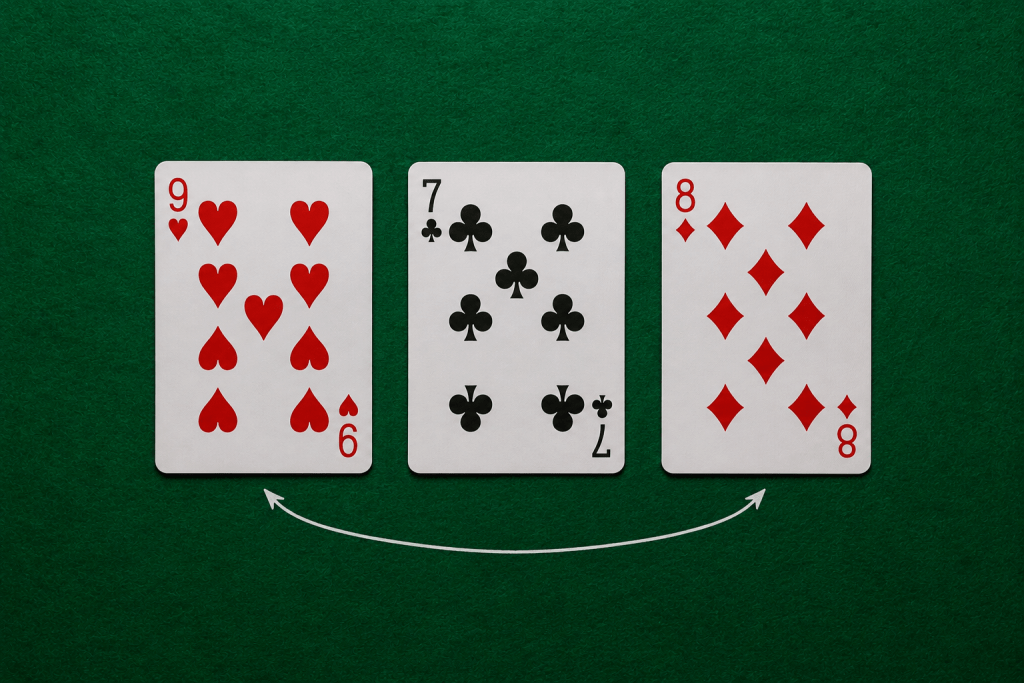
| B plays 8 | 30 | 3 pts to B | Run of 3: 7–8–9 (order of play) |
| A tries K | Would = 40 | — | Over 31, A says “Go” |
| B tries Q, then 5 | Would = 40, 35 | — | Both over 31, B also can’t play |
| B scores | — | 1 pt to B | B played the last card (the 8) before the stall |
| Count resets to 0 | |||
| A plays 9 | 9 | 0 | Nothing yet |
| B plays 5 | 14 | 0 | No scoring condition |
| A plays K | 24 | 0 | No scoring condition |
| B tries Q | Would = 34 | — | Over 31, and Q was B’s last card |
| A scores | — | 1 pt to A | A played the last card (the K) before the stall, and has no cards left to try |
| Count resets to 0 | |||
| B plays Q | 10 | 1 pt to B | B still had the Q, so pegging continues — last card of the pegging phase |
Key things this example shows:
- Runs are based on the order cards were played, not their face value order — 9, 7, 8 created a run of 7–8–9
- A “Go” point goes to whoever played the last card successfully, not necessarily the player who says “Go” — in the first sequence that’s B, in the second it’s A
- The count resets after a Go and play continues with remaining cards
- Several counts can happen in the same pegging phase — pegging only ends when every card has been played
👉 Now that you understand pegging, learn how to do it well: Cribbage Pegging Strategy
End of Pegging
Pegging ends when:
- All cards have been played
- The final count does not exceed 31
Hands are then scored in this order:
- Non-dealer’s hand
- Dealer’s hand
- Dealer’s crib
👉 Learn what happens next: Cribbage Endgame Rules
Common Pegging Mistakes
Beginners often:
- Miss runs formed by card order
- Forget to score pairs immediately
- Score a Go incorrectly
- Play high cards too early
🃏 Free Printable
Free Cribbage Cheat Sheet (Printable)
New to cribbage? Download this free printable and keep it beside you while you play — covers scoring combinations, pegging examples, round order, and common beginner mistakes.
Instant PDF • Printable • Beginner friendly
👉 See more: Common Cribbage Mistakes
Cribbage Pegging Strategy (Practical Tips)
Once you understand the rules, pegging becomes a strategic battle. Small decisions can swing games.
Avoid Leading with 5s
Leading with a 5 allows your opponent to easily score 15 for 2.
Whenever possible, save 5s for later.
Control the Count
Strong pegging positions include:
- Totals of 4, 14, and 24
- Avoid leaving totals of 5, 10, or 21
These numbers reduce your opponent’s scoring options.
Pair Awareness
If you lead with a card:
- Be aware of how easily your opponent can pair it
- Low cards are safer early
Use “Go” to Your Advantage
Sometimes forcing your opponent into a Go:
- Scores you a point
- Gives you control of the next lead
This matters more than it seems.
Don’t Chase Runs Blindly
Runs during pegging are opportunistic.
Trying to force them often gives away easy points.
Pegging vs Hand Value
Sometimes the best pegging move weakens your hand — that’s fine.
Pegging points are guaranteed. Hand points are not.
👉 Discard decisions matter here: Cribbage Discard Strategy
📘 Beginner Guide
Cribbage Made Simple
Keep the pegging rules beside you while you play. This printable guide explains every pegging score with worked examples.
- 6 worked pegging examples: fifteens, 31, pairs, runs, go and last card
- Hand scoring with 9 scored examples
- A fast-start checklist and a practice quiz
26-page printable PDF · 10% off applied at checkout
Practice Pegging
The fastest way to improve pegging is repetition.
👉 Practice here: Play Cribbage Online
👉 App options: Best Cribbage Apps
Quick Reference
Need a fast reminder?
Frequently Asked Questions
Still unsure about a pegging situation?