The cribbage board is what makes cribbage look unusual compared to other card games. While it may seem confusing at first, the board is simply a way to track score accurately and visually as the game progresses.
This guide explains how a cribbage board works, how pegs are used, and how to read your score at any point in the game.
If you’re new, don’t worry — once you understand the layout, the board becomes second nature.
👉 For full gameplay context: How to Play Cribbage
What Is a Cribbage Board?
A cribbage board is a scoring board with a series of holes used to track points from 0 to 121.
Instead of writing scores down, players use pegs to mark their progress as they score points during pegging and hand counting.
Most boards are designed for two players, but many also support three or four players.
Basic Layout of a Cribbage Board


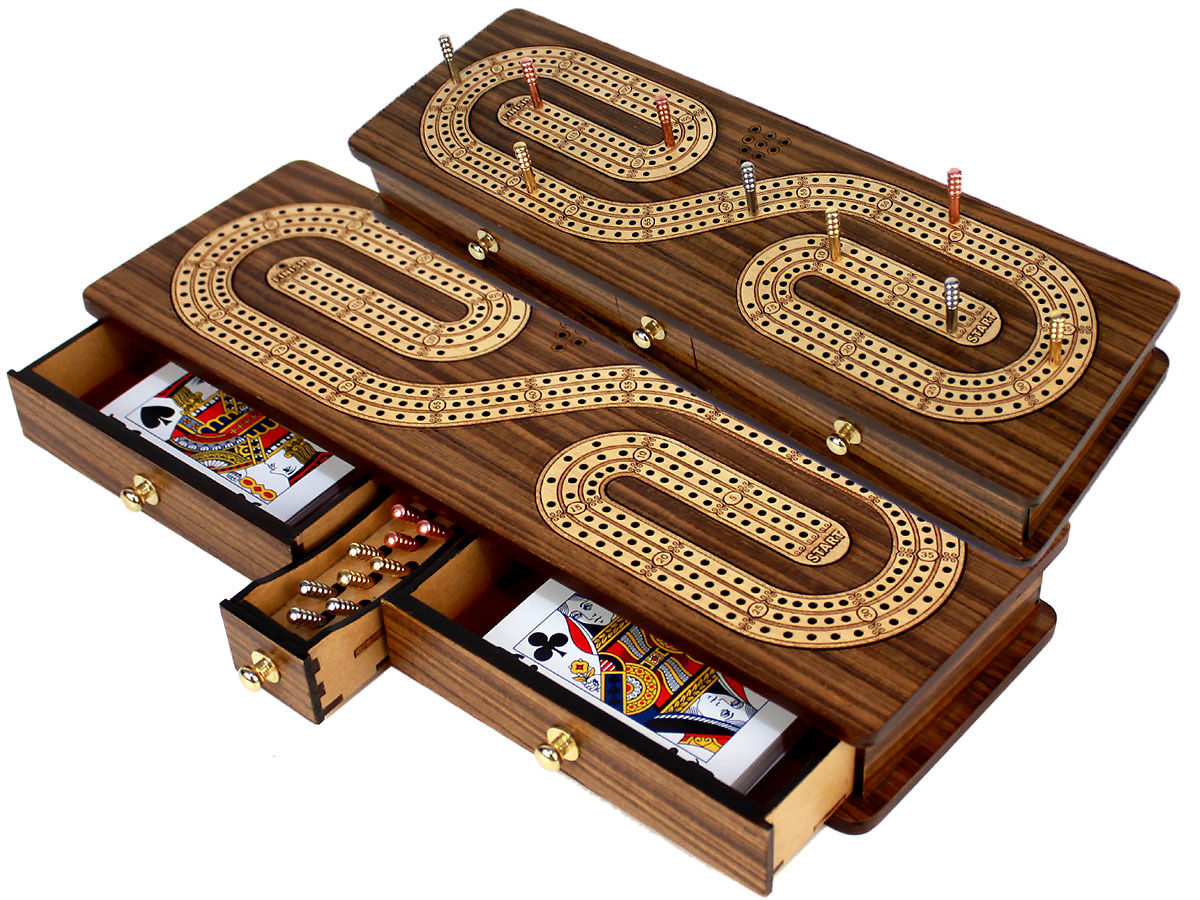
A standard cribbage board includes:
- Two parallel tracks (one per player)
- 121 holes per track
- A starting area
- A finish hole (usually marked differently)
- Peg storage holes at the top or bottom
Each player typically uses two pegs of the same color.
Why Two Pegs Are Used
Players use two pegs so they can always see:
- Their current score
- Their previous score
This is often called “leapfrogging”.
How leapfrogging works:
- One peg marks your current score
- When you score points, you move the other peg forward
- The rear peg stays as a reference
This prevents scoring mistakes and makes it easy to track progress.
Starting Position on the Board
At the beginning of the game:
- Both pegs start in the starting holes (score = 0)
- Players move pegs forward as soon as points are scored
👉 Learn when scoring happens: Cribbage Scoring Explained
How Pegs Move During the Game
You move pegs every time you score points, including:
- During pegging
- When counting your hand
- When scoring the crib (dealer only)
You always move one peg at a time, never both.
👉 Pegging explained here: Cribbage Pegging Rules
Understanding the Rows & Sections
Most boards are divided into:
- Groups of 5 holes
- Sections of 30 holes (often visually separated)
This helps players quickly count:
- Small scores (2–3 points)
- Larger jumps (15, 20, 30+ points)
Some boards label the halfway point at 60 points.
The Finish Hole (121 Points)
The game ends when a player reaches 121 points.
- The final hole is usually larger or visually distinct
- The game ends immediately when a peg reaches 121
- This can happen during pegging or hand scoring
👉 Learn edge cases here: Cribbage Endgame Rules
Common Board Variations
While most boards follow the same logic, designs can vary:
- Straight-line boards
- Oval or circular boards
- Travel boards (compact or folding)
- Decorative wooden boards
Despite visual differences, all boards track the same scoring system.
Do You Need a Cribbage Board?
A physical board is traditional, but not required.
You can also:
- Use a digital board or app
- Track score with paper
- Practice online
👉 Practice options: Play Cribbage Online
That said, most players find a board:
- Faster
- More accurate
- More enjoyable
Common Cribbage Board Mistakes
Beginners often:
- Move both pegs at once
- Forget which peg is the “front” peg
- Skip scoring during pegging
- Miscount hole groups
👉 Avoid errors here: Common Cribbage Mistakes
Quick Tips for New Players
- Always leave one peg behind as a reference
- Move pegs as soon as you score
- Double-check large point jumps
- Watch your opponent’s pegs — mistakes happen
👉 Beginner help: Cribbage Strategy for Beginners
Frequently Asked Questions
If you’re unsure how the board interacts with scoring or pegging rules: